Understanding Codabar Barcodes
Reliability for complex surfaces. Master the symbology trusted by blood banks, libraries, and lab systems for over four decades.
The Lab and Library Standard
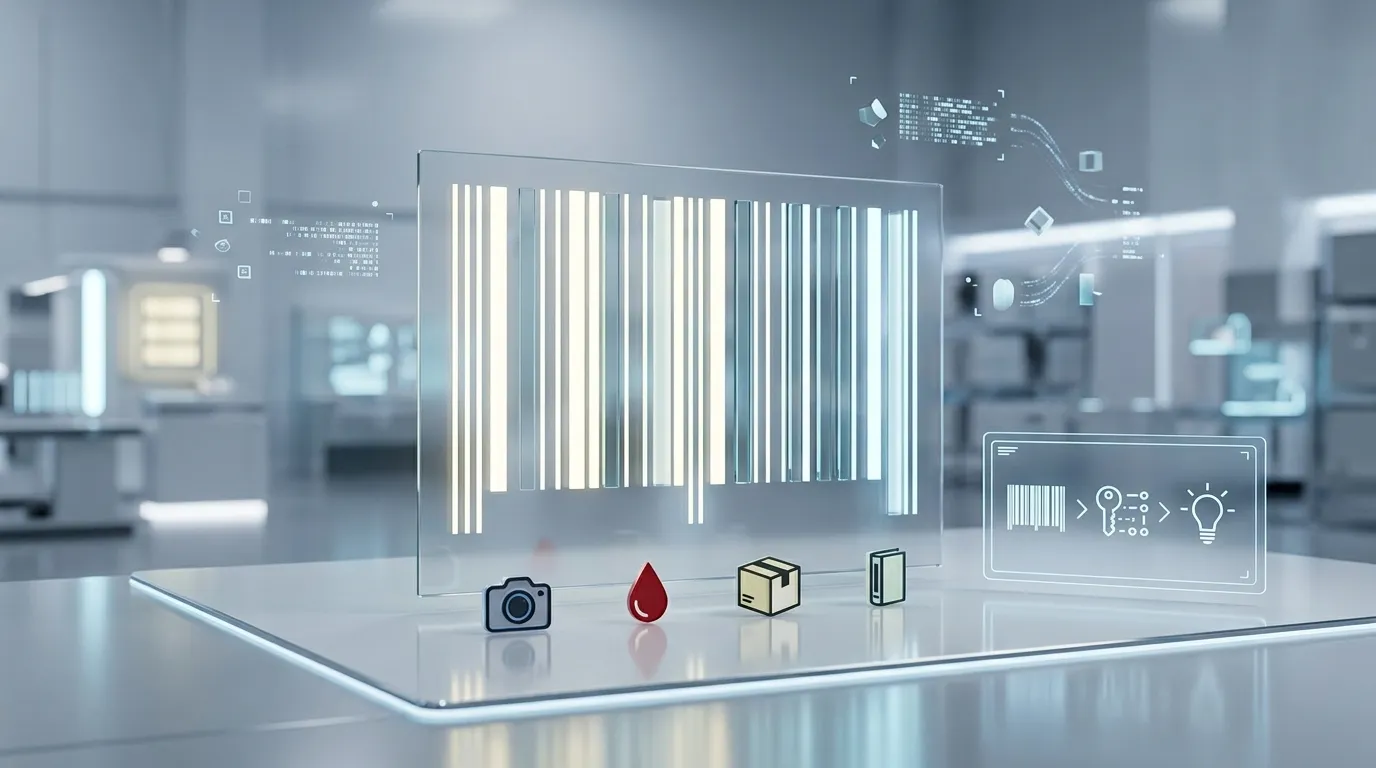
Codabar (also referred to as NW-7, USD-4, or Code 2 of 7) is a discrete, self-checking linear symbology introduced back in 1972. It was specifically engineered to be reliably read even when printed by low-quality dot-matrix printers or applied to highly flexible, wrinkled surfaces like medical blood bags or chemical specimen tubes. You can create Codabar barcodes free with our barcode maker.
Because of its mathematical resilience and ease of printing, Codabar became the legacy standard of choice for American blood banks, academic libraries, photo-finishing labs, and early parcel delivery services (like FedEx airbills).
Start and Stop Characters
The most defining structural feature of a Codabar barcode is its strict requirement for Start and Stop Characters. These are represented by the English letters A, B, C, or D (and occasionally a, b, c, d, t, n, * or e depending on the scanner's firmware).
These characters must strictly cap the beginning and end of every single Codabar string to tell the laser exactly where the data payload begins and terminates. For example, a valid string would be: A123456B.
Character Support limitations
Outside of the Start/Stop letters, Codabar supports a very limited but highly specialized set of characters:
- Numeric Digits: 0 through 9.
- Special Symbols: Dash (-), Dollar ($), Colon (:), Slash (/), Period (.), and Plus (+).
- Control Letters: A, B, C, or D (strictly for Start/Stop positions only).