QR Code vs. Data Matrix
Comparing 2D barcodes for manufacturing. Learn why Data Matrix is the industry standard for microscopic laser-engraving on PCBs and microchips.
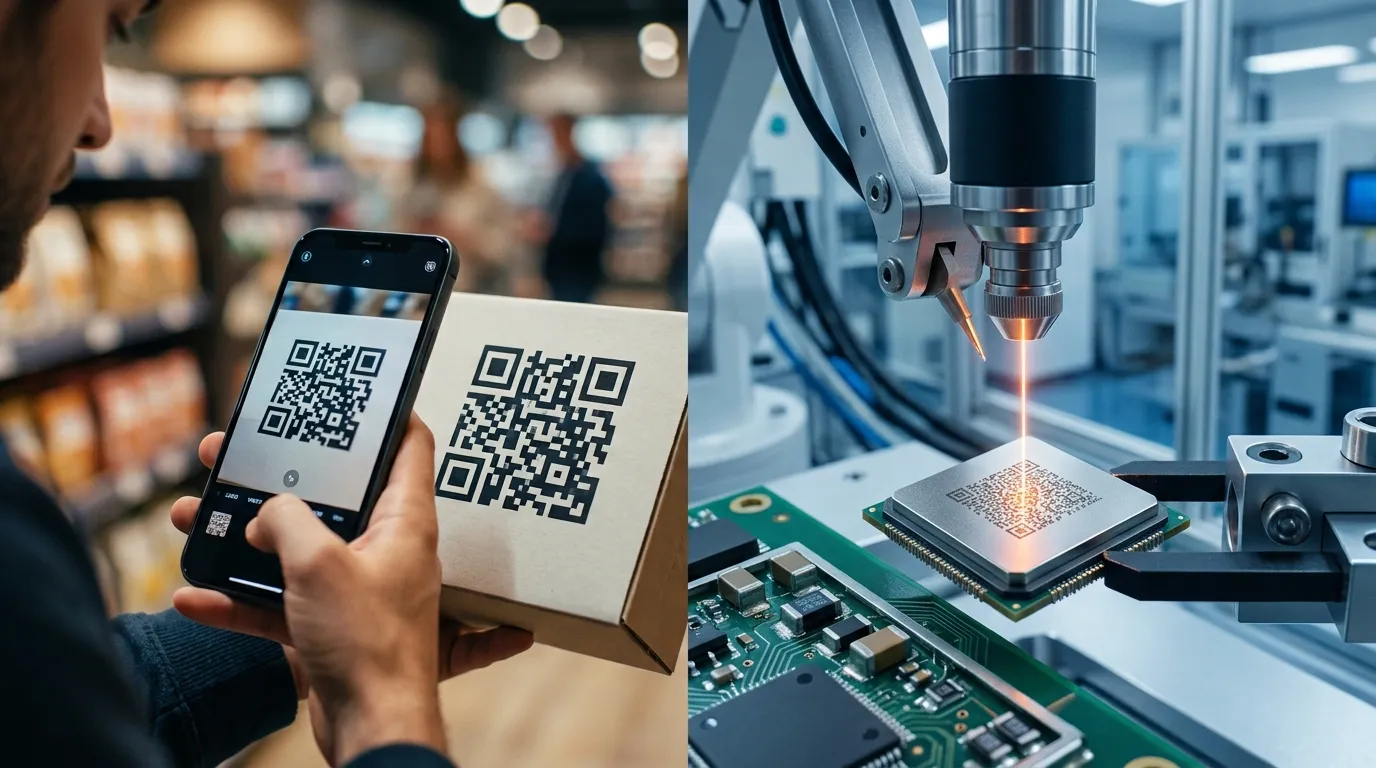
The Microscopic Constraint
When tracking tiny components in the electronics, aerospace, or medical device manufacturing industries, you need a 2D barcode that can survive harsh chemical washes, extreme heat, and remain scannable even when scaled down to microscopic sizes.
The battle usually comes down to QR Code vs Data Matrix. While both are powerful 2D matrix symbologies, they were engineered for entirely different ecosystems.
Why Data Matrix Wins in Hardware
QR Codes are universally recognized by consumers and smartphones for marketing. However, they feature large "finder patterns" (the three prominent squares in the corners) and require a relatively large "quiet zone" (blank border) around the symbol. This fundamentally limits how small a QR code can be printed before a scanner loses alignment.
Data Matrix (specifically the ECC 200 standard) was engineered explicitly for industrial marking. It uses a highly efficient, solid "L-shaped" finder pattern on the left and bottom edges. This lack of bulky corner squares allows the matrix to be scaled down to 2 or 3 millimeters across—roughly the size of a pinhead.
Direct Part Marking (DPM)
Because of its scalability and high fault tolerance (up to 30% damage recovery), Data Matrix is the undisputed global standard for Direct Part Marking (DPM).
Whether you are laser-engraving serial numbers directly onto green PCB silicon wafers, dot-peening heavy automotive engine blocks, or chemically etching surgical scalpels that undergo daily autoclaving, Data Matrix is the required format. Leave QR codes for consumer packaging and advertising.